Short Fiction by Anton Chekhov (libby ebook reader .txt) 📕
Description
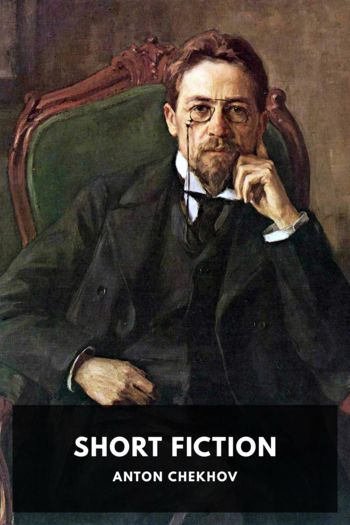
Anton Chekhov is widely considered to be one of the greatest short story writers in history. A physician by day, he’s famously quoted as saying, “Medicine is my lawful wife, and literature is my mistress.” Chekhov wrote nearly 300 short stories in his long writing career; while at first he wrote mainly to make a profit, as his interest in writing—and his skill—grew, he wrote stories that heavily influenced the modern development of the form.
His stories are famous for, among other things, their ambiguous morality and their often inconclusive nature. Chekhov was a firm believer that the role of the artist was to correctly pose a question, but not necessarily to answer it.
This collection contains all of his short stories and two novellas, all translated by Constance Garnett, and arranged by the date they were originally published.
Read free book «Short Fiction by Anton Chekhov (libby ebook reader .txt) 📕» - read online or download for free at americanlibrarybooks.com
- Author: Anton Chekhov
Read book online «Short Fiction by Anton Chekhov (libby ebook reader .txt) 📕». Author - Anton Chekhov
“One has seduced and abducted my sister,” he thought, “another will come and murder my mother, a third will set fire to the house and sack the place. … And all this under the mask of friendship, lofty ideas, unhappiness!”
“No, it shall not be!” Pyotr Mihalitch cried suddenly, and he brought his fist down on the table.
He jumped up and ran out of the dining room. In the stable the steward’s horse was standing ready saddled. He got on it and galloped off to Vlassitch.
There was a perfect tempest within him. He felt a longing to do something extraordinary, startling, even if he had to repent of it all his life afterwards. Should he call Vlassitch a blackguard, slap him in the face, and then challenge him to a duel? But Vlassitch was not one of those men who do fight duels; being called a blackguard and slapped in the face would only make him more unhappy, and would make him shrink into himself more than ever. These unhappy, defenceless people are the most insufferable, the most tiresome creatures in the world. They can do anything with impunity. When the luckless man responds to well-deserved reproach by looking at you with eyes full of deep and guilty feeling, and with a sickly smile bends his head submissively, even justice itself could not lift its hand against him.
“No matter. I’ll horsewhip him before her eyes and tell him what I think of him,” Pyotr Mihalitch decided.
He was riding through his wood and waste land, and he imagined Zina would try to justify her conduct by talking about the rights of women and individual freedom, and about there being no difference between legal marriage and free union. Like a woman, she would argue about what she did not understand. And very likely at the end she would ask, “How do you come in? What right have you to interfere?”
“No, I have no right,” muttered Pyotr Mihalitch. “But so much the better. … The harsher I am, the less right I have to interfere, the better.”
It was sultry. Clouds of gnats hung over the ground and in the waste places the peewits called plaintively. Everything betokened rain, but he could not see a cloud in the sky. Pyotr Mihalitch crossed the boundary of his estate and galloped over a smooth, level field. He often went along this road and knew every bush, every hollow in it. What now in the far distance looked in the dusk like a dark cliff was a red church; he could picture it all down to the smallest detail, even the plaster on the gate and the calves that were always grazing in the church enclosure. Three-quarters of a mile to the right of the church there was a copse like a dark blur—it was Count Koltonovitch’s. And beyond the church Vlassitch’s estate began.
From behind the church and the count’s copse a huge black storm-cloud was rising, and there were ashes of white lightning.
“Here it is!” thought Pyotr Mihalitch. “Lord help us, Lord help us!”
The horse was soon tired after its quick gallop, and Pyotr Mihalitch was tired too. The storm-cloud looked at him angrily and seemed to advise him to go home. He felt a little scared.
“I will prove to them they are wrong,” he tried to reassure himself. “They will say that it is free-love, individual freedom; but freedom means self-control and not subjection to passion. It’s not liberty but license!”
He reached the count’s big pond; it looked dark blue and frowning under the cloud, and a smell of damp and slime rose from it. Near the dam, two willows, one old and one young, drooped tenderly towards one another. Pyotr Mihalitch and Vlassitch had been walking near this very spot only a fortnight before, humming a students’ song:
“ ‘Youth is wasted, life is nought, when the heart is cold and loveless.’ ”
A wretched song!
It was thundering as Pyotr Mihalitch rode through the copse, and the trees were bending and rustling in the wind. He had to make haste. It was only three-quarters of a mile through a meadow from the copse to Vlassitch’s house. Here there were old birch trees on each side of the road. They had the same melancholy and unhappy air as their owner Vlassitch, and looked as tall and lanky as he. Big drops of rain pattered on the birches and on the grass; the wind had suddenly dropped, and there was a smell of wet earth and poplars. Before him he saw Vlassitch’s fence with a row of yellow acacias, which were tall and lanky too; where the fence was broken he could see the neglected orchard.
Pyotr Mihalitch was not thinking now of the horsewhip or of a slap in the face, and did not know what he would do at Vlassitch’s. He felt nervous. He felt frightened on his own account and on his sister’s, and was terrified at the thought of seeing her. How would she behave with her brother? What would they both talk about? And had he not better go back before it was too late? As he made these reflections, he galloped up the avenue of lime trees to the house, rode round the big clumps of lilacs, and suddenly saw Vlassitch.
Vlassitch, wearing a cotton shirt, and top-boots, bending forward, with no hat on in the rain, was coming from the corner of the house to the front door. He was followed by a workman with



Comments (0)